

Everyone knows that exercise is good for you. But I don’t think people really understand the mechanisms behind it, specifically the neurological mechanisms. This makes sense given the cesspool of misinformation you will see on social media with influencers trying to sell you brain-boosting pills containing jelly-fish protein (I’m not kidding) claiming to biohack the brain’s natural mechanisms.
Meanwhile, Silicon Valley bros are microdosing everything from LSD to lion’s mane trying to enhance cognition, others are spending thousands on transcranial stimulation devices, and the nootropics market has exploded to $2.9 billion annually. We’re literally trying to buy what a 30-minute run produces naturally.
I’ve published peer-reviewed papers on neurogenesis and neuroplasticity in the context of neurodegenerative diseases like Parkinson’s and I’ve watched our understanding evolve from “adult brains can’t grow new neurons” (definitively disproven) to today’s nuanced picture of how movement shapes our minds. Quick aside: We are seeing really encouraging results for Parkinson’s and dementia patients when routine exercise is incorporated into their treatment plan. The real story isn’t just that exercise is good for your brain, it’s that your muscles are essentially an endocrine organ, manufacturing a cocktail of brain-enhancing molecules that no pharmaceutical company, and certainly no wellness company, has successfully replicated.
Below, I’m going to describe what happens in your brain when you exercise (spoiler: it’s way more than endorphins), why intensity matters more than duration, and how a molecule your muscles produce during hard efforts literally grows new brain cells.
The Discovery That Changed Everything
For most of the 20th century, neuroscience textbooks taught a depressing “fact”: you’re born with all the neurons you’ll ever have, and it’s all downhill from there. Santiago Ramón y Cajal, the father of modern neuroscience, wrote in 1913: “In adult centers, the nerve paths are something fixed, ended, immutable.”
He was wrong (on this one).
In 1998, Peter Eriksson and Fred Gage published a paper in Nature Medicine that shattered this dogma1. They used BrdU labeling (a technique that tags dividing cells) to prove that adult humans (even older adults) generate new neurons in the hippocampus throughout life. These neurons appear in exactly the right place: the dentate gyrus, crucial for learning and memory.

[Figure 1: The timeline and progression of adult neurogenesis in humans. Graph made with Biorender.]
But here’s where it gets interesting: exercise can double or triple this rate.
Henriette van Praag’s landmark 1999 study in PNAS showed that mice given access to running wheels showed a 2.5x increase in new neuron production2. These weren’t just any neurons, they were functionally integrated into circuits, showing enhanced long-term potentiation (the cellular basis of learning).
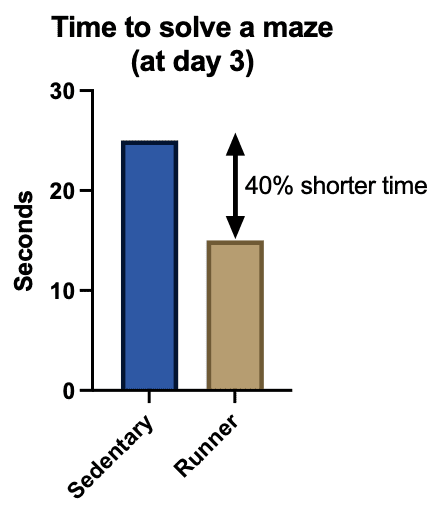

[Figure 2: (Top) Mice allowed to exercise (Runners) were able to solve puzzles and mazes significantly faster than mice not allowed to exercise (Sedentary). (Bottom) An increase in new neurons were seen in the hippocampus of mice that had access to exercise. Data from 2]
In humans, the evidence is equally compelling. Kirk Erickson’s 2011 study published in PNAS followed 120 older adults for a year3. The aerobic exercise group didn’t just maintain hippocampal volume, they increased it by 2%, effectively reversing age-related loss by 1-2 years. The control group lost 1.4% volume over the same period. Those may seem like small percentages but they are incredibly consequential and impactful. Also pay attention to the trend lines below. The hard work will pay dividends in the long run.

[Figure 3: Humans that routinely exercised for a year showed a reversal in hippocampal brain volume loss (degeneration) compared to a group that predominantly stretched. Data from3]
BDNF: The Master Molecule
Brain-derived neurotrophic factor (BDNF) often gets called “Miracle-Gro for the brain,” and the science backs up this seemingly hyperbolic claim. This protein doesn’t just help neurons survive, it fundamentally changes how your brain works.
Here is what we know about BDNF’s effects on the brain4:
- Increases dendritic spine density (connection number between neurons)
- Enhances long-term potentiation (strength of connections)
- Protects against stress-induced neural damage
- Facilitates synaptic plasticity (ability of neurons to adapt)
- Promotes neuronal differentiation and survival
Here’s what we know about exercise and BDNF from actual human studies:
Strength training does not appear affect BDNF levels5. But aerobic exercise does and that the intensity matters enormously6:
- Light intensity endurance exercise: No significant BDNF change
- Moderate/High intensity endurance exercise: ~13% increase
- Maximal (graded) intensity: ~30% increase

[Figure 4: BDNF increases are dependent on exercise intensity. Data from6]
But here’s the fascinating part: the BDNF gene has a common variant (Val66Met polymorphism) that affects about 30% of the population (varies significantly by ethnicity). People with this variant release less BDNF and show smaller improvements from exercise. A study found that Met carriers didn’t show the same hippocampal volume increases from exercise as Val carriers7.
The Lactate Revolution
For decades, we thought lactate was just metabolic waste that makes your muscles burn. This was completely wrong. We now know that lactate is critical for maintaining neural circuits8. A groundbreaking 2019 study showed that lactate itself promotes learning and memory9.
Here’s what happens: During exercise, muscle-derived lactate crosses the blood-brain barrier through MCT transporters. In the brain, it:
- Serves as an energy substrate (neurons actually prefer it to glucose)
- Induces expression of plasticity genes including BDNF
- Promotes long-term memory formation
- Enhances synaptic plasticity
The researchers proved this by directly infusing lactate into mice brains, it improved memory even without exercise. They also showed that blocking lactate transport eliminated exercise’s cognitive benefits.
This explains why intensity matters so much. You need to reach the lactate threshold, the point where lactate production exceeds clearance, typically around 65-85% of maximum heart rate. That burning in your muscles? That’s your body manufacturing brain medicine.
Depression, Anxiety, and the Exercise Prescription
The antidepressant effects of exercise are so robust that some researchers argue it should be a first-line treatment. A 2023 systematic review in the British Journal of Sports Medicine analyzed 97 reviews encompassing 1,039 trials and 128,119 participants10. The findings:
- Exercise showed a significant additive effect at reducing depression/depressive symptoms, anxiety, and psychological distress when combined with standard treatment
- All exercise types were beneficial, but resistance training showed the largest effects
- Higher intensity correlated with greater improvements
Note: This is NOT an endorsement of diminishing the effects of anti-depressant medications – they have quite literally saved and will continue so save lives. Rather, it is to encourage adding in exercise to current treatment plans.
But why does it work? Jorge Ruas’s team at the Karolinska Institute discovered a remarkable mechanism in 201411. During exercise, muscles increase production of PGC-1α1, which in turn boosts kynurenine aminotransferases (KATs). These enzymes convert kynurenine, a metabolite linked to depression, into kynurenic acid, which can’t cross the blood-brain barrier.
Essentially, your muscles act as a filter, removing depression-promoting molecules from your bloodstream. Additionally, exercise normalizes HPA axis function in depressed patients, reducing cortisol and increasing neuroplasticity12.
The Protocol That Actually Works
Based on the current evidence, here’s what optimizes exercise for brain health:
Weekly structure (based on multiple meta-analyses):
- 2-3x moderate aerobic (30-45 min): Base for BDNF and neurogenesis
- 1-2x high-intensity intervals (20-30 min): Maximum BDNF spike
- 1-2x resistance training: Additional neuroprotective benefits
The lactate threshold target: Based on the lactate research, aim for:
- 65-85% maximum heart rate
- “Comfortably hard”—you can speak 3-4 words maximum
- At least 10 minutes at this intensity
Recovery matters: Overtraining (>90 minutes daily at high intensity) can disrupt hormonal balance and cause maladaptive endocrine responses, which can negatively affect cognitive function13. Recovery days are when neuroplasticity occurs.
What Doesn’t Work
Low-intensity “neurobic” exercises: While beneficial for other reasons, gentle yoga or tai chi don’t significantly increase BDNF or neurogenesis (though they may improve cognition through other mechanisms like stress reduction).
Exercise in isolation: The benefits are enhanced by:
- Social interaction (group exercise shows 15-20% greater cognitive improvement)
- Environmental enrichment (outdoor > treadmill)
- Learning new movement patterns (dance, martial arts)
The Bottom Line
Exercise is non-negotiable for neurological health. Your brain is remarkably plastic, capable of growing new neurons and forming new connections throughout life. Exercise is the single most powerful tool we have to enhance this plasticity. Every time you exercise intensely enough to get breathless, you’re:
- Triggering neurogenesis in your hippocampus
- Releasing BDNF to strengthen synaptic connections
- Producing lactate that directly enhances memory
- Filtering depression-promoting molecules from your blood
- Reversing age-related brain shrinkage
No supplement, drug, or brain-training app comes close to exercise’s validated effects. The pharmaceutical industry has spent decades trying to create a “BDNF pill”, they’ve all failed because BDNF is just one piece of an intricate system that exercise activates.
The evidence is clear: moderate to vigorous exercise, 30-45 minutes, 4-5 times per week, will measurably improve your brain structure and function. The effects begin immediately but compound over months and years.
Your muscles are waiting to manufacture brain medicine. Your cardiovascular system is ready to flood your brain with growth factors. The smartest thing you can do for your brain is to move it.
Stay Curious,
Andrew

References
- Eriksson PS, et al. Neurogenesis in the adult human hippocampus. Nature Medicine. 1998;4(11):1313-1317.
- Van Praag H, et al. Running enhances neurogenesis, learning, and long-term potentiation in mice. PNAS. 1999;96(23):13427-13431.
- Erickson KI, et al. Exercise training increases size of hippocampus and improves memory. PNAS. 2011;108(7):3017-3022.
- Cotman CW, Berchtold NC, Christie LA. Exercise builds brain health: key roles of growth factor cascades and inflammation. Trends in Neurosciences. 2007;30(9):464-472.
- Goekint M, et al. Strength training does not influence serum brain-derived neurotrophic factor. European Journal of Applied Physiology. 2010;110(2):285-293.
- Ferris LT, Williams JS, Shen CL. The effect of acute exercise on serum brain-derived neurotrophic factor levels and cognitive function. Medicine & Science in Sports & Exercise. 2007;39(4):728-734.
- Brown BM, et al. Influence of BDNF Val66Met on the relationship between physical activity and brain volume. Neurology. 2014 Oct 7;83(15):1345-52. doi: 10.1212/WNL.0000000000000867. Epub 2014 Sep 3. PMID: 25186863.
- Pellerin L, Magistretti PJ. Glutamate uptake into astrocytes stimulates aerobic glycolysis: a mechanism coupling neuronal activity to glucose utilization. PNAS. 1994;91(22):10625-10629.
- El Hayek L, et al. Lactate mediates the effects of exercise on learning and memory through SIRT1-dependent activation of hippocampal brain-derived neurotrophic factor (BDNF). Cell Metabolism. 2019;29(4):1071-1085.
- Singh B, et al. Effectiveness of physical activity interventions for improving depression, anxiety and distress: an overview of systematic reviews. British Journal of Sports Medicine. 2023;57(18):1203-1209.
- Agudelo LZ, et al. Skeletal muscle PGC-1α1 modulates kynurenine metabolism and mediates resilience to stress-induced depression. Cell. 2014;159(1):33-45.
- Deslandes A, et al. Exercise and mental health: many reasons to move. Neuropsychobiology. 2009;59(4):191-198.
- Cadegiani FA, Kater CE. Hormonal aspects of overtraining syndrome. Frontiers in Physiology. 2020;11:858.
Leave a Reply